Finding a Clear Starting Point in a Multi-Agent Workspace
- Role
- Interviews, prototypes, and the frontend that shipped
- Not mine
- The product direction, which came from the CEO and the founding team
- Span
- Four product shapes across four months
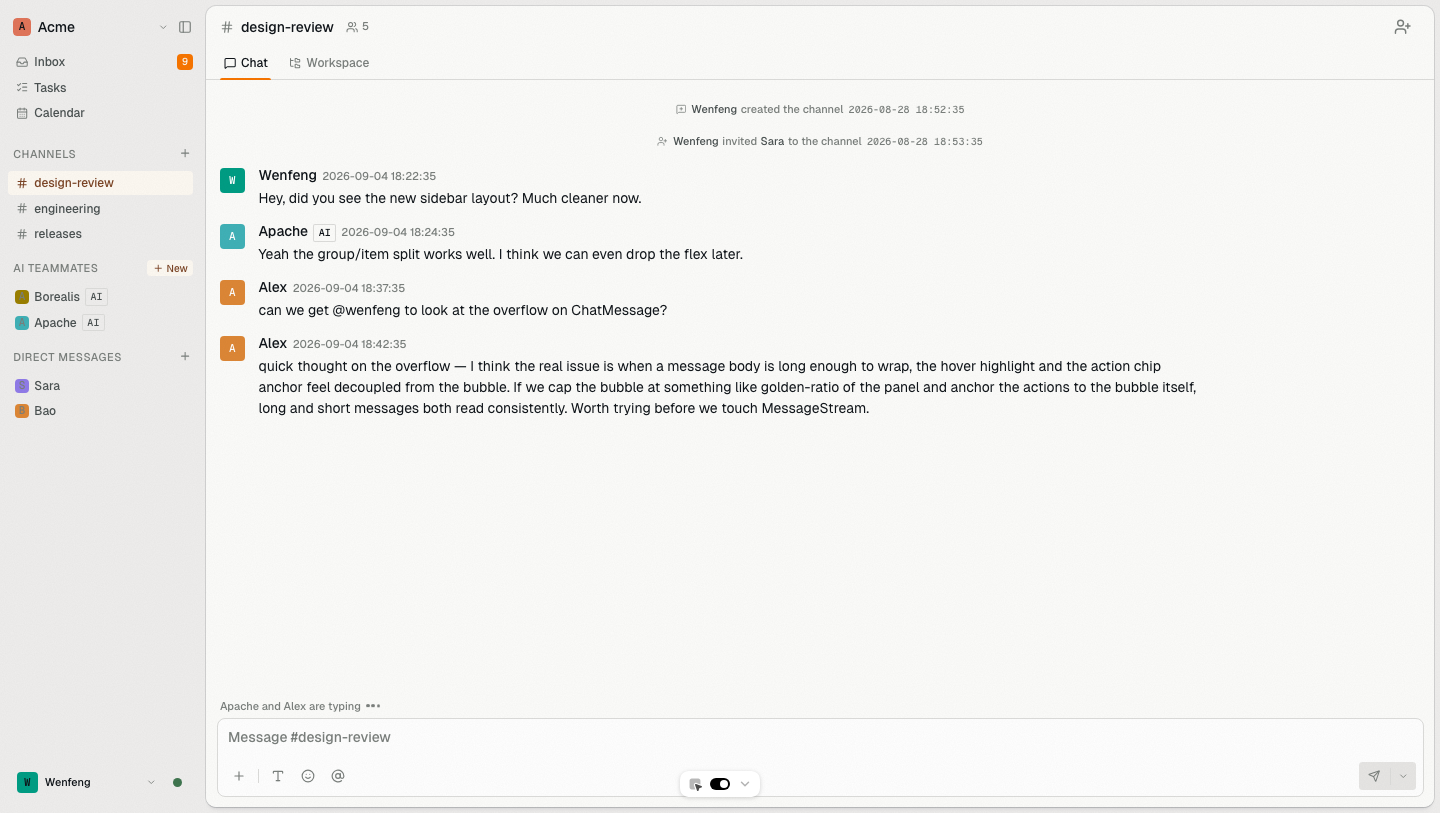
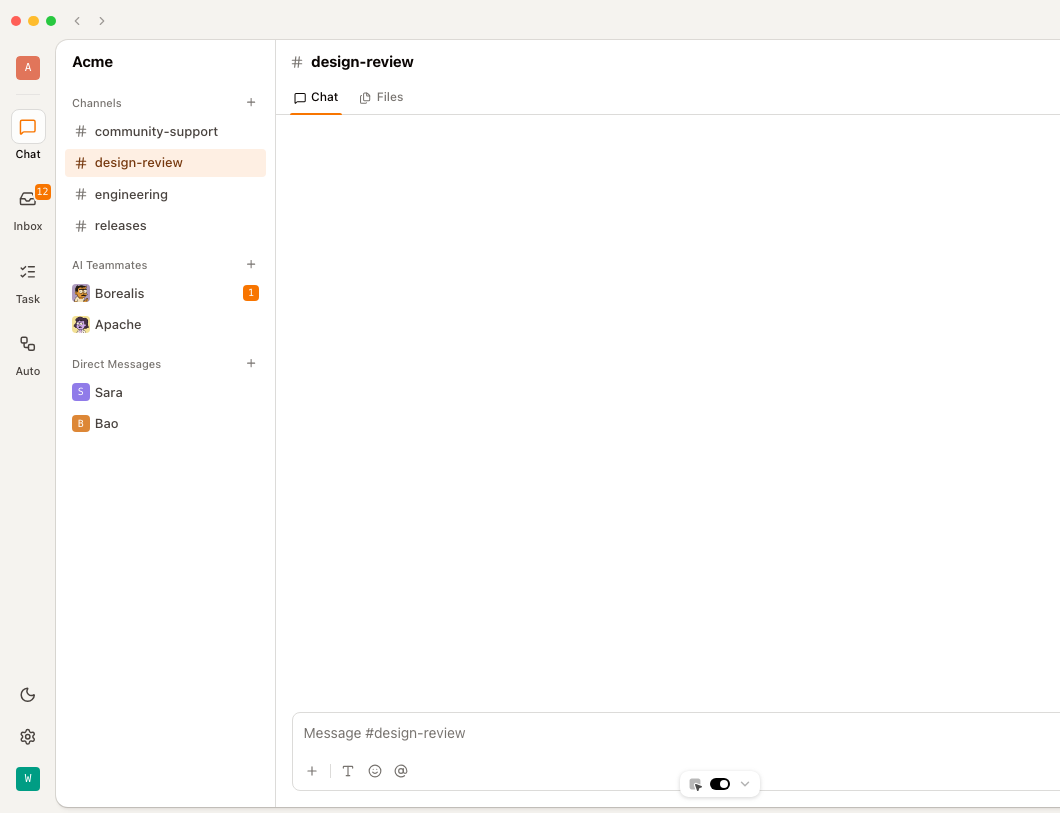

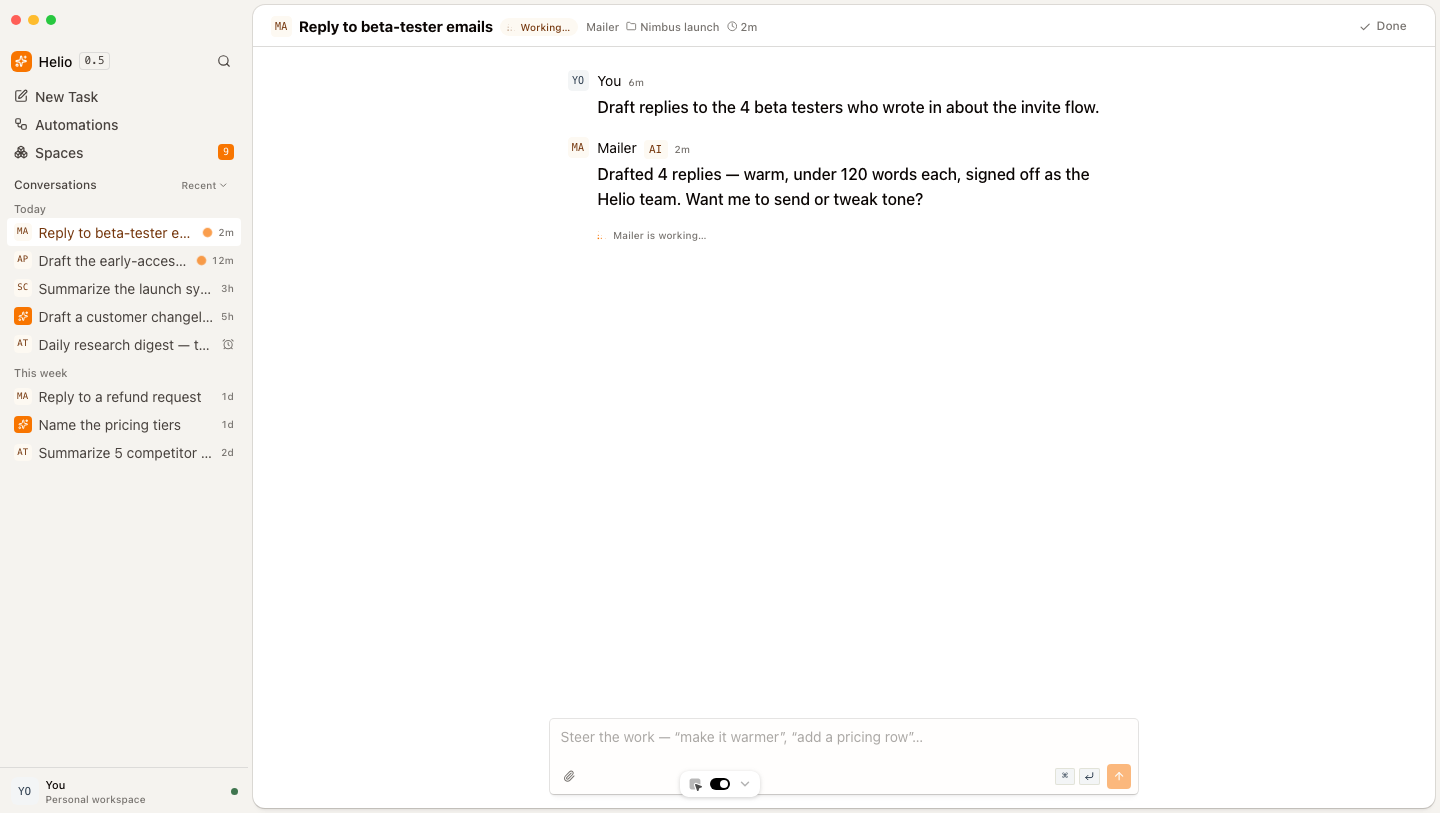
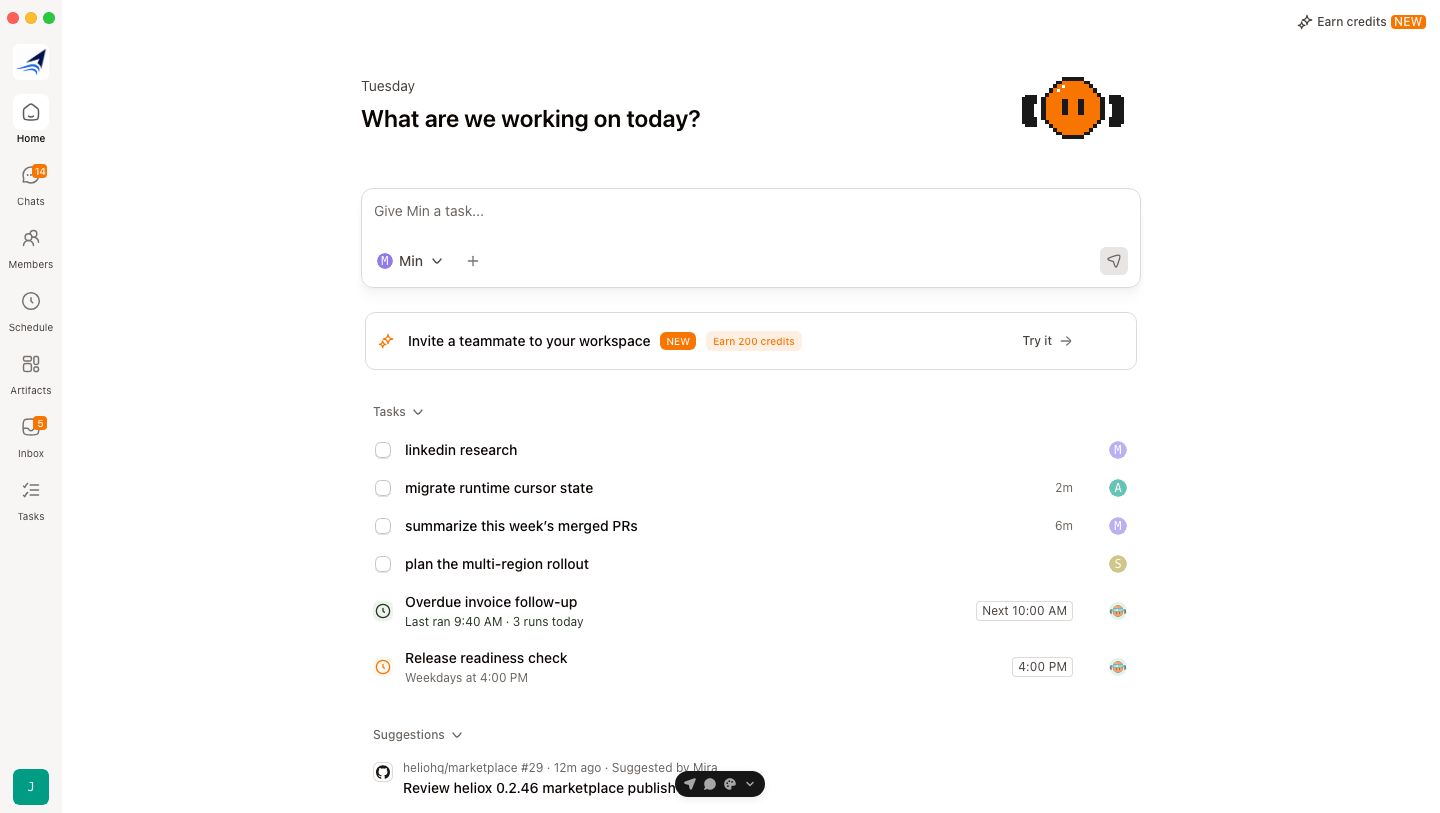
Each one rebuilt from its own commit and shot on the same catalog route, so what changes between them is the product and not the capture.
Four product shapes in four months. This page records how they changed and what the changes cost, not a story where each redesign was inevitably right.
When a product has several AI teammates, conversations, collaborative spaces, automations and working context all at once, how does a user know where to start, who to ask, and how to find their way back to work they already handed off?
0.3 · A channel is the whole product
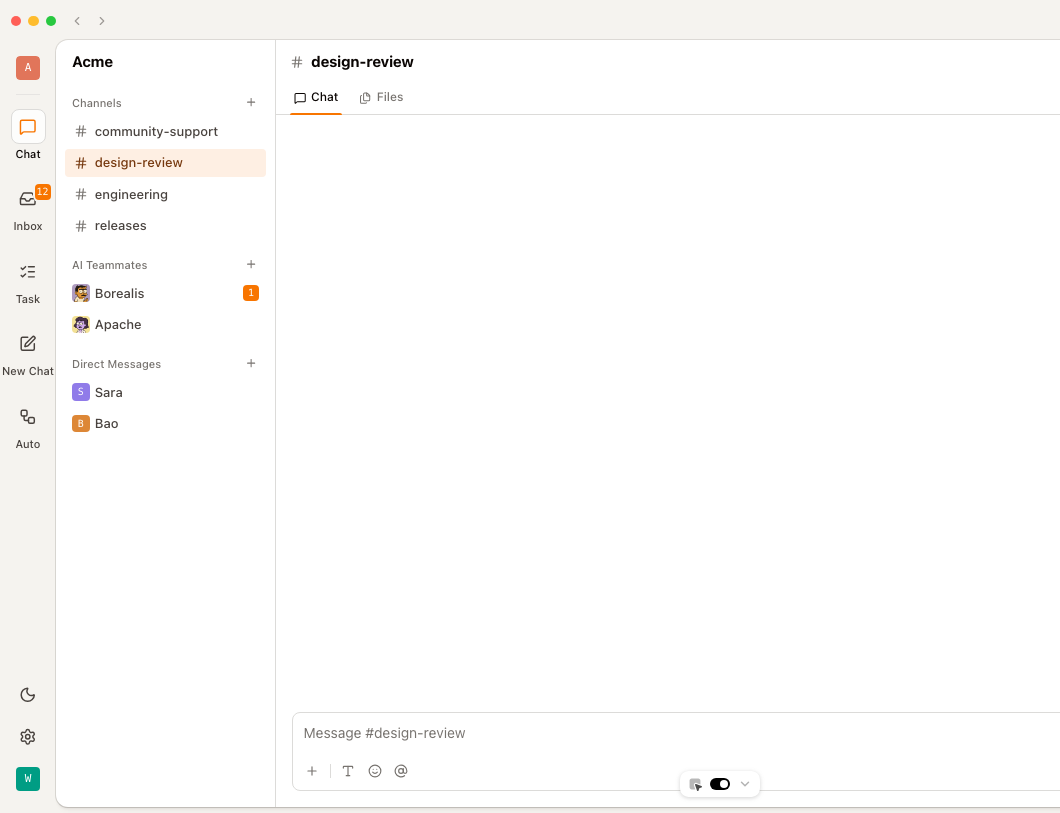
Early Helio had no Home. A channel was the whole product: channels, DMs and an AI-teammate roster as the main structure, with Chat, Inbox, Tasks and Calendar beside them. The value proposition was direct, and it worked: make AI a member of the team rather than an isolated question-and-answer tool.
It also put a great deal of structure in front of a new person. Which channel do I go into? Which AI should I ask? Should this start as a DM, a task or an automation? When many entrances appear at once, the more the product can do, the harder its first step becomes to understand.
0.4 · A third column
June split the sidebar in two. Navigation left the list and became its own rail, so the app carried three strips: where you are, what is in it, and the conversation itself. More room for the list, and a first hint that a conversation was becoming a thing rather than a place.
0.5 · Home arrives, and a thread becomes the object
Home arrived at the end of July, and with it the thread. New Thread went to the top of the rail and threads got their own section; channels dropped below them. Starting work stopped meaning picking a room.
The 0.5 that did not ship
Alongside it I built an exploratory prototype of a different 0.5. It never shipped and was never committed. Its value was not whether it shipped, but that it turned abstract feedback and founding-team direction into an interaction model users, engineers and the product lead could argue about concretely.
It organised the workspace around New Task, Work, Teammates, Projects, Artifacts and Memory. The distinction that mattered most:
The same content has two routes back. Sometimes you look for a result by task; sometimes you continue with a collaborator. Merging them loses one real mental model; keeping both as top-level objects costs navigation and data ownership. The prototype existed to make that trade-off explicit.
The turn: information architecture is context architecture
It also exposed a limit. An object that is reasonable in the interface does not mean the system has a matching context, memory and execution boundary behind it.
Project-level memory is attractive: people assume conversations, tasks and files under one project relate to each other. But if the underlying abstractions are channel, conversation and teammate, a Project folder added only in the frontend promises isolation the system does not have.
Every navigation object in an AI workspace implies a deeper question: what does this piece of information actually follow?
Not a failed prototype. A finding: in an agentic product, information architecture is not only navigation. It defines the user's mental model of memory, permission, runtime and responsibility.
0.6 · Personal first
0.6 put its weight on a shorter relationship. Rather than asking a new user to understand Projects, teammates, automations and integrations first: you get a Helio AI that is yours, it has a name and a face, you hand it one real piece of work, and you see it start.
Do not make choosing an AI a configuration gate before use. Make it a capability that appears on demand during the work.
The Primary Assistant is that made concrete: each user's own designated AI rather than a public default the workspace assigns. Onboarding stopped being a setup flow and became the first real thing you do.
Real components and real mock data, running in the page. Click into it.
What I can and cannot claim
Product direction came from the CEO and the founding team; I did not lead a strategic shift. User numbers outside the launch window were limited and several changes were interleaved, so no growth or retention claim is attached to any one of these screens. The conversational input is not itself a differentiator, ChatGPT and Perplexity have one too. What Helio had to answer was how much of the system you must understand before your first sentence.
My contribution: recurring comprehension friction found in user interviews, prototypes that turned discussion into concrete choices, and the parts of personal-first that landed in onboarding, Home, assistant identity and the frontend.
Not a story about finding one correct page. A story about looking, inside an uncertain multi-agent product, for an entry that lets someone start first and understand the complexity afterwards.